
Parents may become concerned when they notice messy handwriting in children. A child may have difficulty with letter formation, spacing, pen or pencil holding, or writing speed. Sometimes, parents may wonder whether messy handwriting is simply a habit or whether it indicates a deeper problem.
The Callistyle handwriting improvement course focuses on identifying a child’s existing handwriting and individual needs and then working on handwriting skills step by step.
What Can Messy Handwriting in Children Look Like?
Messy handwriting can involve different aspects of writing.
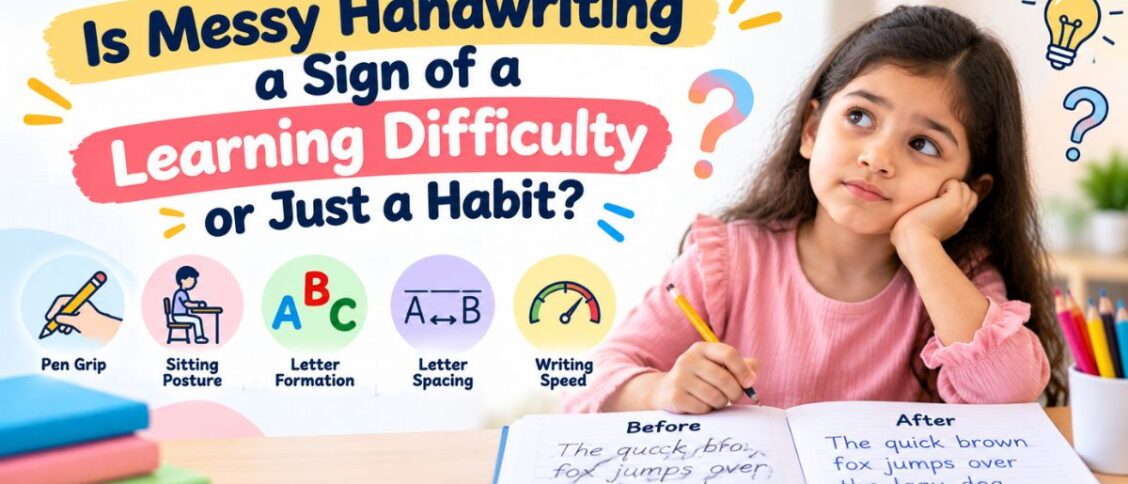
Based on the areas covered in the Callistyle course, children may need to work on:
- Pen or pencil holding
- Sitting posture
- Hand positioning
- Basic strokes
- Alphabet formation
- Spacing between letters
- Words
- Sentences
- Paragraphs
- Writing speed
This shows why handwriting improvement should not focus only on whether writing looks neat or untidy.
A child’s handwriting can have different areas that need attention, and the first step in the Callistyle approach is to identify the student’s handwriting and needs.
Is Messy Handwriting Always a Learning Difficulty?
Messy handwriting by itself does not tell us the reason behind a child’s writing difficulties.
The Callistyle webpage focuses on handwriting improvement rather than diagnosing learning difficulties. Its course begins by observing the student’s handwriting and identifying individual needs.
Instead of assuming why a child’s handwriting is messy, the course works on specific handwriting skills such as:
- Correct pen or pencil holding
- Sitting posture
- Basic strokes
- Alphabet formation
- Spacing
- Words and sentences
- Paragraph writing
- Speed writing
If parents have concerns beyond handwriting practice or are worried about a child’s overall learning development, they can seek appropriate guidance from a qualified professional.
Common Handwriting Skills Children Can Work On
The Callistyle course provides a structured approach to handwriting improvement.
Pen or Pencil Holding
The course starts with correcting pen or pencil holding.
How a child holds the writing instrument is one of the basic areas covered before progressing to other handwriting skills.
Sitting Posture
Sitting posture is also included in the basic training.
Children are guided on handwriting fundamentals before moving toward strokes and letters.
Basic Strokes
The course introduces basic strokes before alphabet formation.
These strokes become the foundation for learning and practising letters.
Alphabet Formation
Children then learn alphabets through basic strokes.
This allows them to work on individual letter formation before progressing to words and sentences.
Spacing
Callistyle also teaches the right way of spacing letters.
Spacing is an important part of the course learning objectives and can be practised as children move toward words, sentences, and paragraphs.
Writing Speed
Speed writing training is also included in the course.
Children can therefore work on writing speed along with other handwriting skills.
How Does Callistyle Approach a Child’s Handwriting?
Callistyle follows an Observation, Engagement, Appreciation approach.
The first step is to identify the student’s existing handwriting and needs.
After that, training begins with the basics.
The overall progression includes:
Hand/Pencil Holding → Sitting Posture → Basic Strokes → Alphabets → Words → Sentences → Paragraphs → Speed Writing
Feedback is provided throughout the process to keep the learner engaged, while appreciation is used to encourage the learner to enjoy the work.
Why Individual Attention Matters in Handwriting Improvement
Every child may have different handwriting needs.
One child may need more practice with pen holding. Another may need help with alphabet formation or spacing. Another may need to work on writing speed.
Callistyle provides individualized feedback through experienced tutors.
The course uses small batches with a maximum of 2–3 students with one instructor.
This allows the trainer to supervise progress and provide individual attention during handwriting practice.
Can Messy Handwriting Improve With Regular Practice?
Callistyle’s course places significant emphasis on practice.
Practice worksheets are provided after every handwriting improvement course session.
The course also includes:
- Assignments
- Practical training
- Video tutorials
- Visual learning
- Informative PDFs
- Personalized feedback
These resources give children opportunities to continue practising the skills covered during their sessions.
The course also provides downloadable content with lifetime access.
What Handwriting Styles Can Children Learn?
Callistyle provides training in different handwriting styles.
Children can work on:
Cursive Handwriting
The course includes cursive handwriting improvement.
Printed Handwriting
Printed handwriting improvement is also available.
Lucida/Italic Handwriting
The course also includes Lucida/Italic handwriting improvement.
The training progresses from basic strokes and alphabets to words, sentences, and paragraphs.
Can Parents Help With Messy Handwriting in Children?
Parents can encourage children to practise regularly using the worksheets and learning materials provided as part of the course.
The Callistyle course includes practice worksheets after sessions and also provides assignments and practical training.
Parents can support the child by encouraging regular practice and following the handwriting techniques introduced during the course.
The course also provides flexible class schedules and timings.
What Are the Benefits of Improving a Child’s Handwriting?
Callistyle lists several benefits associated with good handwriting.
These include:
- Stimulating brain activity
- Improved grades
- Boosting confidence
- Improving retention power
- Improving thinking skills
The course information also highlights the idea that the more a learner writes, the more they learn.
Therefore, handwriting practice can become part of a child’s regular writing and learning routine.
Can Young Children Join Handwriting Improvement Classes?
Yes.
Callistyle’s handwriting improvement course is available for learners aged 4 years and above.
The course is suitable for children who need to work on their handwriting basics as well as students and other learners.
For young children, the course begins with foundational skills such as pen or pencil holding, sitting posture, and basic strokes.
How Long Does Handwriting Improvement Take?
Callistyle lists specific course durations for its handwriting programs:
- Cursive Handwriting – 16 classes
- Printed Handwriting – 16 classes
The course also provides revision classes after completion.
According to the course information, revision support is provided for four months, along with handwriting practice and continuous follow-ups.
The course page does not provide one fixed timeframe for every child’s handwriting improvement. The training instead follows the learner’s existing handwriting and individual needs.
What If a Child Continues to Have Messy Handwriting?
If a child continues to struggle with handwriting, it can be useful to look at the specific handwriting areas that need attention.
Parents can observe whether the child needs more practice with:
- Pen or pencil holding
- Sitting posture
- Basic strokes
- Alphabet formation
- Letter spacing
- Words
- Sentences
- Paragraphs
- Writing speed
Callistyle’s approach is to identify the student’s handwriting and needs before beginning the structured training process.
If parents have concerns about areas outside handwriting itself, they should seek appropriate professional guidance rather than assuming that messy handwriting alone indicates a particular learning difficulty.
How Can Parents Support Handwriting Practice at Home?
Regular practice can help children stay engaged with handwriting improvement.
Parents can encourage children to:
- Practise the worksheets provided
- Complete handwriting assignments
- Follow the techniques taught during sessions
- Practise basic strokes
- Practise alphabets
- Write words and sentences
- Work on spacing
- Practise paragraphs
- Continue writing exercises
Callistyle also provides revision classes and continued follow-ups after the main course.
Support Provided After the Handwriting Course
Handwriting improvement does not end with the final regular class.
Callistyle provides:
- Revision classes
- Four months of revision support
- Handwriting practice after course completion
- Continuous follow-ups
- Assistance after course completion
This gives learners additional opportunities to continue practising their handwriting skills.
What Does the Callistyle Handwriting Course Include?
The course provides a structured handwriting learning experience with:
- Live interactive sessions
- Experienced trainers with 7+ years of experience
- Small batches
- Individual attention
- Personalized feedback
- Practice worksheets
- Assignments
- Practical training
- Video tutorials
- Visual learning
- Informative PDFs
- Speed writing training
- Flexible class schedules
- 12×7 doubt clarification
- Revision classes
- Certificate
- Downloadable content
- Lifetime access to downloadable content
- Support after course completion
The course is designed for learners aged 4 years and above.
Frequently Asked Questions
Is messy handwriting in children always a sign of a learning difficulty?
Not necessarily. The Callistyle course information focuses on handwriting improvement and does not diagnose learning difficulties. It begins by identifying the child’s handwriting and individual needs and then works on specific handwriting skills.
What can cause a child’s handwriting to look messy?
The Callistyle course addresses several handwriting areas that may need improvement, including pen or pencil holding, sitting posture, basic strokes, alphabet formation, spacing, words, sentences, paragraphs, and writing speed.
How can parents help children improve messy handwriting?
Parents can encourage regular handwriting practice using worksheets, assignments, and other learning materials provided through the course.
What age can children start handwriting improvement?
Callistyle’s handwriting improvement course is available for learners aged 4 years and above.
Does the course teach correct pen or pencil holding?
Yes. Correcting pen or pencil holding is included in the basic handwriting training.
Does the course include handwriting practice worksheets?
Yes. Practice worksheets are provided after handwriting improvement course sessions.
Does the course include writing speed training?
Yes. Speed writing training is included in the course syllabus.
Does Callistyle provide individual attention?
Yes. The course uses small batches of a maximum of 2–3 students with one instructor and provides personalized feedback.
Does the course provide support after completion?
Yes. Callistyle provides revision classes, four months of revision support, continuous follow-ups, handwriting practice, and assistance after course completion.
Does Callistyle provide certification?
Yes. The handwriting course is certification based, and certification is provided after completion.
Final Thoughts
Messy handwriting in children can involve different handwriting skills, including pen or pencil holding, sitting posture, basic strokes, alphabet formation, spacing, writing speed, and the ability to form words, sentences, and paragraphs.
Instead of making assumptions about the reason behind a child’s handwriting, the Callistyle approach begins by observing the student’s existing handwriting and identifying individual needs.
The course then provides structured training, personalized feedback, practice worksheets, small batches, experienced trainers, revision classes, and continued support.
For parents concerned about a child’s handwriting, focusing on the specific writing skills that need practice can be a useful starting point. If there are broader concerns about the child’s learning or development, those concerns should be discussed with an appropriately qualified professional.
do follow us on: Facebook