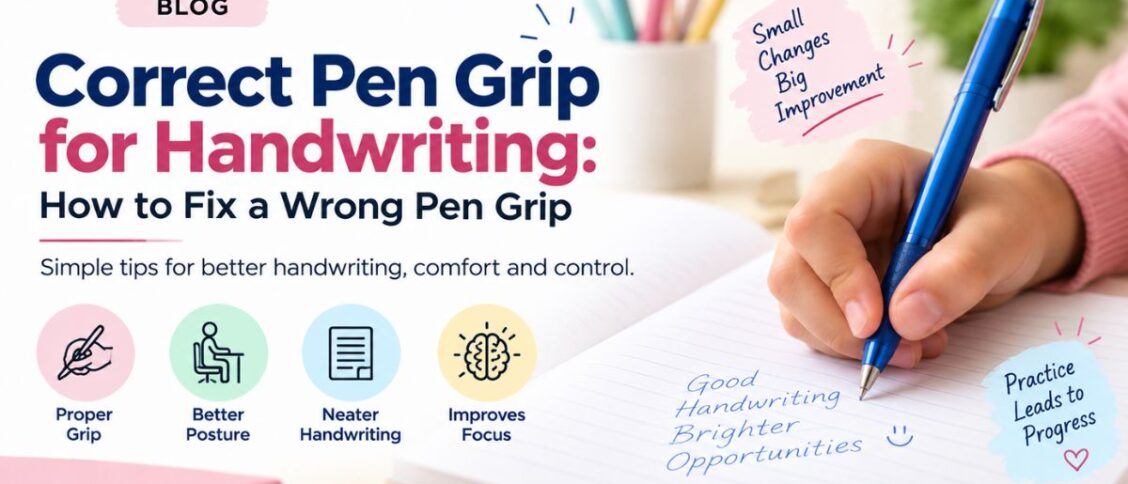

Handwriting is a skill that develops through proper technique, practice, and consistent guidance. One of the first things students learn in a structured handwriting improvement course is how to hold a pen or pencil correctly. An incorrect grip can make writing uncomfortable and can affect control, spacing, and the overall appearance of handwriting.
Learning the correct pen grip for handwriting is therefore an important part of developing better writing habits. At Callistyle, handwriting training begins with the basics, including correcting pen or pencil holding and sitting posture before students move on to strokes, alphabets, words, sentences, and paragraphs.
Why Is the Correct Pen Grip for Handwriting Important?
The way a student holds a pen or pencil is one of the basic elements of handwriting practice. According to the Callistyle course approach, students first have their handwriting and individual needs identified before training begins.
The course starts with fundamental aspects such as correcting pen or pencil holding and sitting posture while writing. Once these basics are addressed, students progress through basic strokes and then learn alphabets using those strokes.
This step-by-step approach helps students build their handwriting skills from the basics rather than simply focusing on the appearance of finished writing.
What Is the Correct Pen Grip for Handwriting?
The correct pen grip for handwriting should allow the learner to write comfortably while maintaining control of the pen or pencil.
Callistyle’s handwriting training focuses on correcting pen or pencil holding as part of its foundational training. This is followed by practice with basic strokes, alphabets, words, sentences, and paragraphs.
Instead of immediately trying to change the entire handwriting style, students are guided through the basics first. This allows them to practise the techniques taught during their sessions and gradually work toward improved handwriting.
How a Wrong Pen Grip Can Affect Handwriting Practice
A student’s handwriting involves more than simply forming letters. The Callistyle course covers several elements, including:
- Proper hand positioning while writing
- Correct pen or pencil holding
- Sitting posture
- Basic strokes
- Letter formation
- Spacing between letters
- Words, sentences, and paragraphs
- Writing speed
This means that correcting pen grip is part of a broader handwriting improvement process.
When students learn the fundamentals first, they can then practise the techniques through worksheets and continued handwriting practice.
5 Things to Check When Practising Pen Grip
When working on handwriting improvement, students can focus on the fundamentals taught in structured handwriting training.
1. Check Your Pen or Pencil Holding
Pen or pencil holding is one of the first areas addressed during Callistyle’s training. Before progressing to advanced handwriting exercises, students are trained in the correct way of holding their writing instrument.
2. Pay Attention to Sitting Posture
Writing posture is another basic element included in the course syllabus. Students learn to correct their sitting posture along with pen or pencil holding.
3. Practise Basic Strokes
After the basics are mastered, students are taught basic strokes. These strokes form the foundation for learning alphabets.
4. Practise Letter Formation
Once students become familiar with basic strokes, alphabets are taught through those strokes. This provides a structured path from simple movements to complete letters.
5. Continue With Words and Sentences
The training then progresses to words, sentences, and paragraphs. Speed-writing training is also provided as part of the course.
Correct Pen Grip for Children: Why Early Practice Matters
Callistyle’s handwriting improvement course is available for learners aged 4 years and above. The course is designed for children, students, professionals, parents concerned about their child’s handwriting, and other learners who want to improve their penmanship.
The course focuses on developing handwriting skills from the basics. For younger learners, this includes areas such as pen or pencil holding, sitting posture, basic strokes, and alphabet formation.
The goal is to give learners an opportunity to practise these fundamentals consistently.
How Handwriting Improvement Training Works
Callistyle follows an Observation, Engagement, and Appreciation approach.
The training begins by identifying the student’s existing handwriting and individual needs. Students are then trained from the basics, beginning with pen or pencil holding and sitting posture.
The learning process continues through:
- Correcting pen or pencil holding
- Correcting sitting posture
- Learning basic strokes
- Learning alphabets through basic strokes
- Practising words
- Practising sentences
- Practising paragraphs
- Developing writing speed
- Receiving feedback throughout the process
This structured approach connects correct pen grip for handwriting with broader handwriting development.
Why Practice Is Important for Handwriting Improvement
Learning a technique is only one part of handwriting development. Students also need opportunities to practise what they learn.
Callistyle provides worksheets after handwriting improvement course sessions. These worksheets are designed to help students practise the concepts taught during their classes.
Revision classes and handwriting practice are also provided after course completion. According to the course information, revision classes continue for four months, with continued follow-ups after the course.
Regular practice can help students continue working on the techniques they have learned.
Handwriting Improvement Beyond Pen Grip
Correcting pen grip is an important foundation, but the Callistyle course covers several other aspects of handwriting.
Students can receive training in:
- Cursive handwriting
- Printed handwriting
- Lucida/Italic handwriting
- Letter spacing
- Basic strokes
- Writing speed
- Words and sentences
- Paragraph writing
The course therefore approaches handwriting as a complete skill rather than focusing on only one aspect.
How Personalized Feedback Supports Handwriting Practice
Individual feedback is another part of Callistyle’s course approach.
The course provides personalized feedback and supervision of student progress. Students can receive individual attention to help address their handwriting-related problems.
Callistyle also states that its batches have a small number of students, allowing learners to receive more individual attention during the sessions.
This can be particularly useful when a learner needs guidance with basic handwriting techniques such as pen holding, posture, strokes, or spacing.
Can You Improve Handwriting With a Normal Pen?
Handwriting improvement does not necessarily require a special writing instrument. The Callistyle course itself includes training around pen or pencil holding and handwriting practice.
The course FAQ specifically addresses whether handwriting can be improved with a normal pen, while the training focuses on the techniques involved in handwriting development.
The emphasis is on learning the correct fundamentals and practising them consistently.
Correct Pen Grip for Handwriting and Writing Speed
Writing speed is another component of Callistyle’s handwriting training.
After students work through basic strokes, alphabets, words, sentences, and paragraphs, speed-writing training is also provided.
This is particularly relevant for students who want to develop both handwriting quality and writing speed. Practising handwriting consistently can give students an opportunity to work on these skills together.
Handwriting Improvement Course for Kids and Other Learners
Callistyle’s course is not limited to one type of learner. The webpage states that the course can be learned by:
- Students
- Business owners
- Working professionals
- Homemakers
The course is available for anyone aged 4 years and above.
Whether the learner is a child working on basic handwriting skills or an adult looking to improve penmanship, the training follows a structured approach beginning with fundamental techniques.
What Does the Callistyle Handwriting Improvement Course Include?
The course includes several features designed to support learning and continued practice:
- Online learning
- Mobile-friendly classes
- Practical assignments
- Downloadable content
- Doubt clearing
- Certificate after course completion
- Experienced trainers
- Individual attention
- Flexible class schedules
- Demo class
- Practice worksheets
- Revision classes
- Support after course completion
The course is available from beginner to advanced level and is conducted in English.
Course Duration and Handwriting Styles
Callistyle provides training in different handwriting styles.
The course information lists:
Cursive Handwriting: 16 classes
Printed Handwriting: 16 classes
Students can learn different handwriting styles while working on the fundamental techniques of handwriting development.
Why Choose a Structured Handwriting Improvement Course?
For learners who struggle with handwriting, simply writing more may not always provide structured guidance. Callistyle’s approach begins by identifying the student’s handwriting and needs and then works through the fundamentals.
The process includes pen or pencil holding, sitting posture, basic strokes, alphabets, words, sentences, paragraphs, and speed writing.
Worksheets, feedback, revision classes, and continued practice are also included to support the learning process.
Frequently Asked Questions
How do I start improving my handwriting?
Start with the fundamentals. Callistyle’s training begins by identifying the student’s handwriting and needs and then works on pen or pencil holding, sitting posture, and basic strokes before moving to alphabets, words, sentences, and paragraphs.
Is the Callistyle Handwriting Course certified?
Yes. Callistyle states that students receive certification after completing the course.
Is handwriting improvement difficult for young kids?
Callistyle’s course is designed for learners aged 4 years and above and begins with basic handwriting techniques before progressing to more advanced writing practice.
Can you improve your handwriting with a normal pen?
The course includes training related to pen or pencil holding and handwriting practice. Callistyle also addresses this question in its course FAQs.
How long does it take for handwriting to improve?
The time required can vary between learners. Callistyle provides structured classes, practice worksheets, revision classes, and continued handwriting practice to support improvement.
At what age can a child begin to improve handwriting?
According to the course information, Callistyle’s handwriting improvement course is available for learners aged 4 years and above.
Can handwriting be improved online?
Yes. Callistyle offers its handwriting improvement course online, allowing learners to participate from home.
Does Callistyle provide workbooks?
Yes. Callistyle states that it provides workbooks to help students practise and improve their handwriting
Start Working on Your Handwriting Today
Developing better handwriting begins with the basics. Learning the correct pen grip for handwriting, improving sitting posture, practising basic strokes, and gradually progressing to alphabets, words, sentences, and paragraphs can create a structured path for handwriting practice.
Callistyle’s Handwriting Improvement Course follows this step-by-step approach for learners aged 4 years and above. The course includes online classes, worksheets, individual feedback, revision classes, speed-writing training, and continued support.
A demo class is also available for interested learners who want to understand the course before enrolling.
Follow Callistyle on Facebook for handwriting improvement tips, course updates, and learning resources.