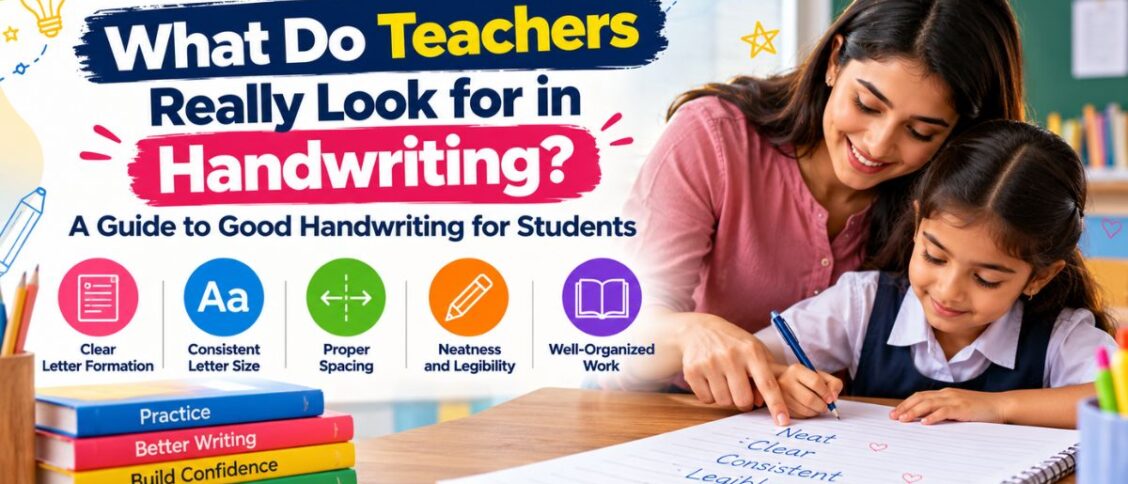

When students write in notebooks, assignments, or exams, handwriting plays an important role in presenting their work clearly. But what actually makes handwriting good? Is it simply about writing beautifully, or are there other skills involved?
Good handwriting for students involves several basic elements, including proper hand positioning, correct pen or pencil holding, spacing between letters, formation of alphabets, words and sentences, writing speed, and consistent practice.
Callistyle’s handwriting improvement course follows a structured approach that begins with handwriting basics and gradually develops writing skills through practice, feedback, and guidance.
What Does Good Handwriting for Students Include?
Good handwriting is not limited to making letters look attractive. Students can work on several aspects of handwriting to make their writing more structured and readable.
According to the Callistyle course approach, important areas include:
- Proper hand positioning
- Correct pen or pencil holding
- Proper sitting posture
- Basic handwriting strokes
- Alphabet formation
- Correct spacing between letters
- Words and sentences
- Paragraph writing
- Writing speed
- Regular practice
These skills are introduced progressively so that students can understand and practise each part of handwriting.
1. Proper Pen or Pencil Holding
One of the first things students learn in handwriting improvement is how to hold a pen or pencil correctly.
Incorrect pen or pencil holding can affect the way a student writes. Therefore, Callistyle’s handwriting course starts with the basics by correcting pen or pencil holding and sitting posture.
Learning proper hand positioning provides a foundation before moving into alphabet and word formation.
Students can also practise these fundamentals regularly through handwriting worksheets provided as part of the course.
2. Correct Sitting Posture
Handwriting is also connected with how a student sits while writing.
Callistyle includes sitting posture as part of the basic handwriting training. Before students move toward advanced writing practice, they are guided on the fundamentals of writing posture and hand positioning.
Developing these habits can make handwriting practice more structured.
3. Basic Strokes Before Alphabets
Students do not immediately start with complete words and paragraphs.
Callistyle’s course syllabus begins with basic strokes. These strokes are then used to teach alphabets.
The progression includes:
Basic strokes → Alphabets → Words → Sentences → Paragraphs
This step-by-step approach helps students understand how individual writing movements come together to form letters and complete written content.
4. Clear Alphabet Formation
Alphabet formation is another important part of good handwriting for students.
Callistyle trains learners in alphabets through basic strokes before progressing to words and sentences.
The course also offers different handwriting styles, including:
- Cursive handwriting
- Printed handwriting
- Lucida/Italic handwriting
Students can therefore practise different styles while working on their handwriting skills.
5. Proper Spacing Between Letters
Even when individual letters are formed properly, spacing can affect the overall appearance of handwriting.
Callistyle specifically includes learning the right way of spacing letters as one of the course learning objectives.
Students can practise maintaining suitable spacing while progressing from letters to words, sentences, and paragraphs.
6. Writing Words, Sentences and Paragraphs
Good handwriting practice should move beyond individual alphabets.
Once students learn the basic strokes and alphabets, Callistyle’s syllabus progresses toward:
- Words
- Sentences
- Paragraphs
This gives students opportunities to practise handwriting in longer pieces of writing rather than only copying individual letters.
Regular worksheet practice after sessions can help students continue working on these skills.
7. Writing Speed
For students, handwriting is not only about appearance. They may also need to develop their writing speed.
Callistyle includes speed writing training as part of the handwriting improvement course.
Students can practise writing while working on handwriting formation, spacing, and overall writing technique.
8. Consistent Practice
One of the key parts of handwriting improvement is regular practice.
Callistyle provides practice worksheets after handwriting improvement course sessions. These worksheets allow students to practise the techniques covered during their classes.
The course also provides assignments and practical training.
The approach focuses on continuous practice rather than treating handwriting improvement as something that happens in a single session.
9. Individual Feedback
Students can have different handwriting needs. One student may need help with pen holding, while another may need to work more on spacing, letter formation, or writing speed.
Callistyle uses personalized feedback as part of its course structure.
Experienced tutors supervise student progress and provide individualized feedback. The small-batch format, with a maximum of two to three students with one instructor, supports individual attention.
This can help students understand which areas of their handwriting they need to practise.
10. Observation and Understanding the Student’s Needs
Callistyle’s handwriting syllabus includes an Observation, Engagement, Appreciation approach.
The process begins by identifying the student’s existing handwriting and individual needs.
Students are then trained from the basics, followed by continuous feedback and appreciation.
This approach makes handwriting practice more personalized instead of following exactly the same process for every learner.
Why Good Handwriting for Students Matters
Callistyle lists several benefits associated with developing good handwriting.
These include:
- Stimulating brain activity
- Improved grades
- Boosting confidence
- Improving retention power
- Improving thinking skills
The course information also highlights the idea that the more students write, the more they learn.
Students can therefore treat handwriting practice as part of their overall writing and learning routine.
Does Good Handwriting Mean Perfect Handwriting?
Students do not necessarily need to create decorative or artistic handwriting.
The Callistyle course focuses on developing handwriting skills through fundamentals such as:
- Hand positioning
- Pen or pencil holding
- Posture
- Basic strokes
- Alphabet formation
- Spacing
- Words
- Sentences
- Paragraphs
- Speed writing
The objective is to help learners understand and practise handwriting techniques in a structured manner.
Students can also learn cursive, printed, or Lucida/Italic handwriting depending on the course.
How Can Students Improve Their Handwriting?
Students can follow a structured practice process:
Start with the basics
Work on pen or pencil holding and sitting posture before focusing on longer writing.
Practise basic strokes
Learn the basic strokes used to form alphabets.
Practise alphabets
Work on individual letter formation and consistency.
Move to words
Once alphabets are comfortable, practise forming complete words.
Write sentences and paragraphs
Use the learned techniques in longer writing exercises.
Work on spacing
Pay attention to the space between letters and words.
Practise writing speed
Gradually include speed writing practice.
Use feedback
Review handwriting regularly and make corrections based on feedback.
Can Students Improve Handwriting Through Online Classes?
Yes. Callistyle offers an online handwriting improvement course designed for learners aged 4 years and above.
The course includes:
- Live interactive sessions
- Video tutorials
- Visual learning
- Informative PDFs
- Practice worksheets
- Assignments
- Practical training
- Personalized feedback
- Doubt clearing
- Revision classes
The course is also mobile-friendly, allowing learners to participate from home.
How Callistyle Helps Students Develop Better Handwriting
Callistyle’s handwriting improvement course is designed for children as well as students, professionals, business owners, homemakers, and other learners.
For students, the course covers the complete handwriting process from basic writing skills to speed writing.
The course includes:
- 7+ years experienced trainers
- Small batches
- Individual attention
- Flexible class schedules
- 12×7 doubt clarification
- Practice worksheets
- Revision classes
- Four months of revision support after course completion
- Continuous follow-ups
- Certificate on completion
- Assistance after course completion
The course duration listed by Callistyle includes 16 classes for Cursive Handwriting and 16 classes for Printed Handwriting.
Frequently Asked Questions
What is good handwriting for students?
Good handwriting for students includes proper hand positioning, pen or pencil holding, sitting posture, basic strokes, clear alphabet formation, appropriate spacing, words, sentences, paragraphs, and writing speed.
How can students improve their handwriting?
Students can start with proper pen or pencil holding and posture, practise basic strokes and alphabets, and gradually move to words, sentences, paragraphs, and speed writing.
Can handwriting be improved through online classes?
Yes. Callistyle provides online handwriting improvement classes with live sessions, video tutorials, visual learning, worksheets, assignments, and personalized feedback.
What age can children start handwriting improvement?
Callistyle’s handwriting improvement course is available for learners aged 4 years and above.
Does the course include writing speed training?
Yes. Speed writing training is included in the Callistyle handwriting improvement course.
Does Callistyle provide handwriting worksheets?
Yes. Practice worksheets are provided after handwriting improvement course sessions.
Does Callistyle provide individual attention?
Yes. Callistyle uses small batches, with a maximum of two to three students with one instructor, along with personalized feedback.
Is there support after completing the handwriting course?
Yes. Callistyle provides revision classes, handwriting practice, continuous follow-ups, and assistance after course completion.
Follow us on Facebook
Final Thoughts
Good handwriting for students is built through a combination of correct writing habits, structured practice, feedback, and regular improvement.
Students can work on pen or pencil holding, sitting posture, basic strokes, alphabets, spacing, words, sentences, paragraphs, and writing speed.
Callistyle’s handwriting improvement course follows this step-by-step approach and provides live online sessions, practice worksheets, personalized feedback, small batches, experienced trainers, revision classes, and post-course support.
With regular practice and guidance, students can continue developing their handwriting skills as part of their everyday writing practice.