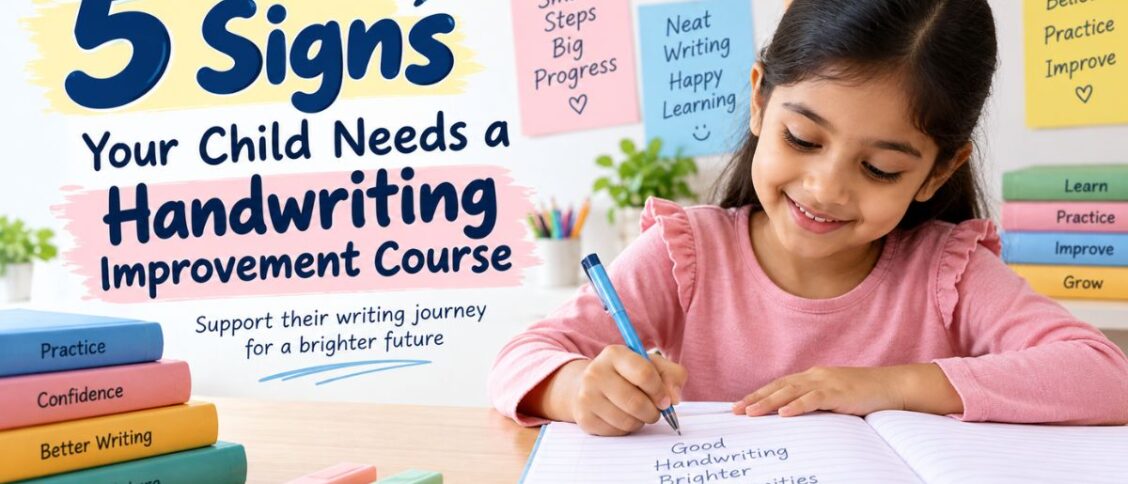

A handwriting improvement course can help children who struggle with messy, inconsistent, slow, or uncomfortable writing. While every child’s handwriting develops differently, persistent difficulties with letter formation, spacing, writing speed, or hand positioning may indicate that the child needs more structured practice and guidance.
Callistyle offers a Handwriting Improvement Course for learners aged 4 years and above, from beginner to advanced levels. The course focuses on proper hand positioning, handwriting improvement, speed-writing training, and correct letter spacing. It also includes practice worksheets, personalized feedback, individual attention, assignments, revision classes, and post-course support.
For parents, it is not always easy to know whether a child simply needs more handwriting practice or would benefit from structured training. Here are five signs that may help you decide.
1. Your Child’s Handwriting Is Consistently Difficult to Read
One of the most noticeable signs is handwriting that remains difficult to read even when the child is writing slowly.
You may notice:
- Letters are difficult to identify
- Similar letters look different each time
- Words appear crowded
- Letter sizes vary significantly
- Writing becomes difficult to read outside the classroom
- The child frequently needs to explain what they have written
Occasional messy handwriting is normal, especially when children are writing quickly. However, if unclear handwriting continues despite regular practice, structured handwriting improvement may be useful.
A handwriting improvement course can help children work systematically on letter formation, spacing, and writing habits rather than simply asking them to write more pages.
2. Your Child Struggles With Letter Formation and Spacing
Good handwriting involves more than knowing the alphabet.
Children need to learn how to form letters consistently and how to maintain appropriate spacing between letters and words.
A child may need additional handwriting support if you regularly notice:
- Letters being formed incorrectly
- Letters touching one another
- Uneven spaces between words
- Letters floating above or below the writing line
- Inconsistent letter size
- Difficulty maintaining the same writing pattern
These problems can make a page look untidy and may make written work harder to read.
Callistyle’s Handwriting Improvement Course specifically includes learning the principles of proper hand positioning and the right way of spacing letters.
3. Your Child Writes Very Slowly
Writing speed is another sign parents can observe.
Some children take much longer than expected to complete written assignments because they concentrate heavily on forming every letter. Others may pause frequently or struggle to maintain a consistent writing flow.
Slow writing can become particularly noticeable when children have to complete longer classroom activities or examinations.
The solution is not simply to tell a child to “write faster.” Speed needs to develop alongside writing control.
Callistyle includes speed-writing training as part of its Handwriting Improvement Course. Students can work on writing speed while continuing to practise the fundamentals of handwriting.
Why Is Writing Speed Important?
A child who spends too much time forming individual letters may have less time available for completing longer written tasks.
Regular practice can help children become more comfortable with continuous writing.
The objective should be to develop writing that is both practical and readable rather than focusing only on maximum speed.
4. Your Child’s Handwriting Gets Worse During Longer Writing
Does your child’s handwriting look fine when writing a few words but become messy after writing for several minutes?
This can be another sign that the child needs more structured handwriting practice.
You may notice that:
- Letters become smaller as the child continues writing
- Spacing becomes inconsistent
- Words start moving away from the writing line
- The child presses the writing instrument harder
- The child frequently stops to rest
- Handwriting becomes increasingly difficult to read
Longer writing requires consistency and control.
Children need opportunities to practise writing beyond individual letters and short words. Sentence, paragraph, and longer writing exercises can help them become more comfortable with continuous writing.
Callistyle’s course includes practice worksheets and practical training to help learners continue practising the concepts covered during their sessions.
5. Your Child Needs Constant Reminders About Hand Positioning
Another sign is when a child repeatedly struggles with the way they position their hand while writing.
Parents may notice:
- An uncomfortable writing position
- Excessive pressure while writing
- Frequent changes in how the writing instrument is held
- Difficulty controlling writing movements
- Complaints of discomfort during writing practice
Proper hand positioning is one of the areas covered in Callistyle’s Handwriting Improvement Course.
Learning appropriate writing habits can give children a structured foundation for improving their penmanship.
Does Every Child With Messy Handwriting Need a Course?
Not necessarily.
Children can have occasional messy handwriting for many ordinary reasons. They may be writing quickly, tired, distracted, or simply developing their writing skills.
The important thing is to look for persistent difficulties.
If the same handwriting problems continue despite regular practice and encouragement, parents may consider whether structured handwriting training would be helpful.
A handwriting improvement course is one possible option for parents who want guided practice, feedback, and a structured learning process.
What Can a Handwriting Improvement Course Teach?
A structured course can break handwriting into smaller skills instead of expecting children to improve everything at once.
Depending on the program, handwriting training may cover areas such as:
- Proper hand positioning
- Basic writing movements
- Letter formation
- Letter spacing
- Word spacing
- Writing consistency
- Writing speed
- Practical handwriting exercises
Callistyle’s course covers proper hand positioning, handwriting improvement, speed-writing training, and the right way of spacing letters.
The course is available from beginner to advanced levels and is designed for learners aged 4 years and above.
How Callistyle’s Handwriting Improvement Course Supports Children
Callistyle provides online handwriting training with a structured learning approach.
According to the course information, learners receive:
Individual Attention
Callistyle provides individual attention, with small batches. The course page states that batches have a maximum of 2–3 students with one instructor for each.
Personalized Feedback
Experienced tutors provide personalized feedback to help learners identify areas that need improvement.
Practice Worksheets
After course sessions, students receive practice worksheets to help them practise the concepts taught during training.
Revision Classes
Callistyle provides revision classes after course completion. The course information states that revision classes continue for four months, along with handwriting practice and follow-ups.
Assignments
The course includes practical assignments, allowing learners to apply what they learn during their sessions.
Doubt Support
Callistyle provides doubt clarification through its support system, with the course page stating that doubts are clarified 12×7.
Post-Course Support
Support does not stop immediately after the course. Callistyle states that assistance, handwriting practice, and continued follow-ups are provided after course completion.
How Parents Can Support Handwriting Improvement at Home
A course can provide structured guidance, but regular practice at home is also important.
Parents can support children by creating a comfortable and consistent practice routine.
Set a Regular Practice Time
Choose a convenient time when the child is not tired or distracted.
Focus on One Problem at a Time
If spacing is the main problem, start with spacing rather than trying to correct every aspect of handwriting simultaneously.
Encourage Practice
Avoid turning handwriting practice into a punishment. Encourage the child to see improvement as a gradual process.
Keep Previous Samples
Save handwriting samples from different stages of practice. Comparing them later can help children see their progress.
Give Positive Feedback
Instead of pointing out only mistakes, acknowledge improvements in letter formation, spacing, or consistency.
Handwriting Improvement Course vs Practising at Home
Parents often wonder whether they should enrol their child in a course or simply practise at home.
Both approaches can be useful depending on the child’s needs.
Home Practice May Be Suitable When:
- The child has only minor handwriting issues
- Parents can provide regular guidance
- The child is willing to practise
- The main goal is additional writing practice
Structured Training May Be Helpful When:
- Handwriting problems continue despite regular practice
- Parents are unsure what needs to be corrected
- The child needs personalized feedback
- The child needs structured speed-writing practice
- The child benefits from an instructor’s guidance
A structured course can provide a defined learning path and feedback rather than leaving parents and children to identify every problem themselves.
When Should Children Start Handwriting Improvement Training?
There is no single age at which every child needs handwriting training.
Callistyle’s Handwriting Improvement Course is available for learners aged 4 years and above.
Starting early can give children an opportunity to develop handwriting habits through structured practice, while older students can work on specific handwriting difficulties and writing speed.
The appropriate approach depends on the child’s existing writing skills and learning needs.
Can a Handwriting Improvement Course Help Before Exams?
Yes, handwriting practice can be particularly relevant when students are preparing for examinations that involve extended written answers.
Students can practise:
- Clear letter formation
- Consistent spacing
- Writing speed
- Paragraph writing
- Longer answers
- Timed writing
However, handwriting improvement should not be limited to the weeks immediately before an examination.
Developing consistent writing habits through regular practice gives students more opportunities to become comfortable with their handwriting.
5 Signs at a Glance
If you are unsure whether your child may benefit from structured handwriting training, look for these five signs:
| Sign | What You May Notice |
|---|---|
| 1. Difficult-to-read handwriting | Letters and words are consistently unclear |
| 2. Poor letter formation and spacing | Letters are uneven, crowded, or inconsistent |
| 3. Very slow writing | The child takes unusually long to complete written work |
| 4. Handwriting worsens during longer writing | Writing becomes messier as the child continues |
| 5. Hand-positioning difficulties | The child struggles with comfortable and controlled writing |
These signs do not mean that every child automatically needs a course. They can simply help parents identify whether additional structured practice may be worth considering.
Why Choose Callistyle for Handwriting Improvement?
Callistyle’s Handwriting Improvement Course is designed for learners from beginner to advanced levels and is available for children aged 4 years and above.
The course highlights include:
- Online learning
- Mobile-friendly learning
- Individual attention
- Small batches
- Practical assignments
- Practice worksheets
- Personalized feedback
- Speed-writing training
- Revision classes
- Doubt clarification
- Flexible class schedules
- Certificate after course completion
- Post-course support
- Experienced trainers with 7+ years of experience
- Downloadable content with lifetime access
Callistyle also provides a demo class for interested learners.
Frequently Asked Questions
What is a handwriting improvement course?
A handwriting improvement course is structured training designed to help learners work on handwriting skills such as hand positioning, letter formation, spacing, consistency, and writing speed.
How do I know if my child needs handwriting improvement?
Look for persistent issues such as difficult-to-read handwriting, poor spacing, inconsistent letter formation, very slow writing, handwriting becoming messy during longer writing, or difficulty with hand positioning.
At what age can a child join a handwriting improvement course?
Callistyle’s Handwriting Improvement Course is available for learners aged 4 years and above.
Can handwriting improve with regular practice?
Regular practice can help learners work on specific handwriting skills. Structured guidance and feedback can make the practice process more systematic.
Can handwriting improvement help with writing speed?
Yes. Speed-writing is one of the areas covered in Callistyle’s Handwriting Improvement Course.
Does Callistyle provide online handwriting classes?
Yes. Callistyle provides its Handwriting Improvement Course online.
Does Callistyle provide personalized feedback?
Yes. The course includes personalized feedback from experienced tutors.
Are practice worksheets provided?
Yes. Practice worksheets are provided after course sessions to help learners practise the concepts covered.
Does Callistyle provide revision classes?
Yes. According to the course information, Callistyle provides revision classes for four months after course completion, along with continued handwriting practice and follow-ups.
Conclusion
Messy handwriting is not necessarily a reason for concern by itself. However, when a child consistently struggles with letter formation, spacing, writing speed, hand positioning, or maintaining readable handwriting during longer writing sessions, additional structured practice may be useful.
A handwriting improvement course can give children a systematic way to practise these skills with guidance and feedback.
Callistyle’s Handwriting Improvement Course is available for learners aged 4 years and above and includes proper hand positioning, handwriting improvement, speed-writing training, spacing, practice worksheets, personalized feedback, assignments, revision classes, and post-course support.
For parents considering handwriting training, identifying the specific difficulties your child experiences is a useful first step. From there, regular practice and appropriate guidance can help the child work toward more consistent and comfortable handwriting.