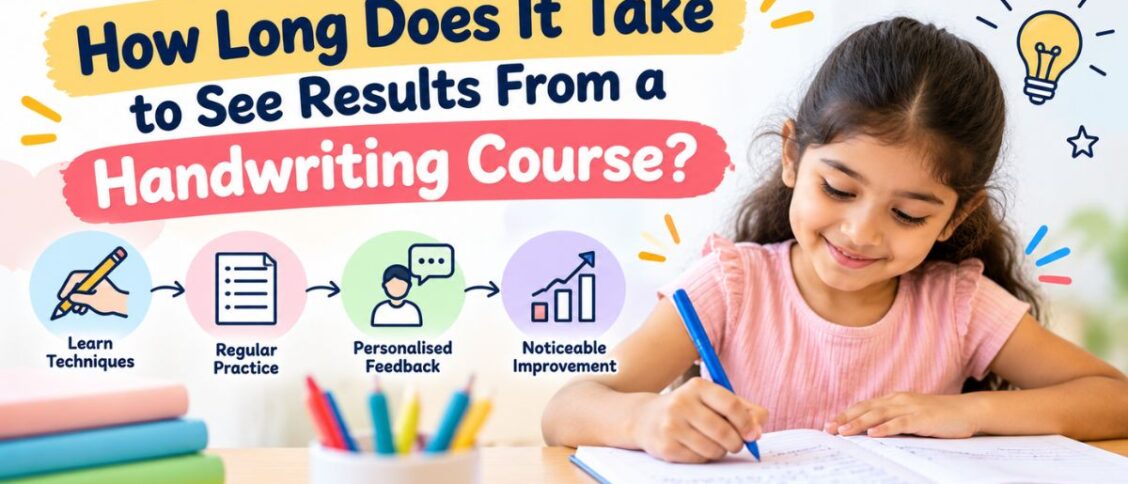

One of the first questions parents and students ask before joining a handwriting improvement course is simple: How long does it take to see results from a handwriting course?
There is no single number of days that applies to every learner. Handwriting develops through instruction, practice, feedback, and repetition, and the time needed to see noticeable changes can depend on the learner’s starting point and consistency.
Research on handwriting interventions has reported measurable improvements over different periods. For example, one study found significant improvements after a two-week handwriting programme, while another 12-week intervention found improved handwriting legibility. Other research has reported improvements following programmes lasting seven or eight weeks.
Callistyle’s Handwriting Improvement Course follows a structured approach that begins with the basics and progresses through strokes, alphabets, words, sentences, paragraphs, spacing, and speed writing.
How Long Does a Handwriting Course Take to Show Results?
The honest answer is that handwriting improvement does not happen at exactly the same speed for everyone.
A learner who practises regularly may progress differently from someone who practises occasionally. The starting level of handwriting, individual needs, consistency, and the type of practice can all influence progress.
Research also shows that handwriting programmes can produce improvements over different timeframes. A study involving elementary students reported significant improvements after two weeks of daily handwriting instruction, while a separate 12-week study found significant improvements in handwriting legibility.
This is why it is better to think of handwriting improvement as a progressive skill-development process, rather than expecting a guaranteed transformation after a specific number of days.
What Does a Handwriting Improvement Course Actually Teach?
A good handwriting improvement course should not focus only on making letters look attractive.
Callistyle’s course begins by identifying the learner’s handwriting and needs. Training then starts with basic elements such as:
- Pen or pencil holding
- Sitting posture
- Basic strokes
- Alphabet formation
- Words
- Sentences
- Paragraphs
- Letter spacing
- Speed writing
The course follows an Observation, Engagement, and Appreciation approach.
This means learners work through handwriting skills progressively instead of trying to change everything at once.
The First Stage: Correcting the Basics
The first stage of Callistyle’s handwriting training focuses on fundamentals.
Students are taught to correct their pen or pencil holding and sitting posture while writing.
These basic areas are addressed before learners move to more advanced handwriting exercises.
For someone with established handwriting habits, beginning with these fundamentals provides a structured starting point for handwriting practice.
The Second Stage: Learning Basic Strokes
Once the basic techniques are addressed, students are taught basic strokes.
These strokes form the foundation for learning alphabets.
The progression used in the course is:
Pen/Pencil Holding → Posture → Basic Strokes → Alphabets
This step-by-step method allows learners to practise one part of handwriting before moving to the next.
The Third Stage: From Alphabets to Words
After learning basic strokes, students learn alphabets through those strokes.
The training then progresses to:
Alphabets → Words → Sentences → Paragraphs
This gradual progression is an important part of handwriting practice.
Instead of only repeating individual letters, learners eventually practise handwriting in longer and more practical forms.
The Fourth Stage: Working on Writing Speed
Handwriting improvement is not only about neatness.
Callistyle also provides speed writing training.
Once learners progress through the foundational stages, speed-writing practice is included.
Research on handwriting interventions has found that structured handwriting instruction can improve writing fluency, although improvements in speed do not necessarily occur in exactly the same way as improvements in legibility. A meta-analysis of handwriting interventions in K–6 students found a significant positive effect on writing fluency.
This highlights why handwriting training can involve several different outcomes rather than one single measure of improvement.
Why Consistent Handwriting Practice Matters
One of the most important parts of improving handwriting is practice.
Callistyle provides practice worksheets after course sessions. These worksheets are designed to help learners practise the concepts taught during their classes.
The course also provides revision classes after course completion. According to the course information you provided, revision classes continue for four months, along with handwriting practice and follow-ups.
Research also supports the importance of sufficient handwriting practice. A systematic review of curriculum-based handwriting programmes found small-to-medium improvements in legibility, while research on handwriting instruction has identified practice and structured intervention as important components of improvement.
Can You See Handwriting Improvement in a Few Weeks?
Research suggests that measurable handwriting changes can occur within weeks, but the exact timeframe varies.
One study of 26 students found significant improvement after two weeks of one-hour-per-day handwriting instruction, with improvements in parent ratings remaining significant at three months.
Another study involving a 12-week handwriting programme found significant improvement in handwriting legibility among students receiving intensive handwriting practice.
A separate eight-week handwriting programme also reported improvements across several handwriting measures, including legibility, form, alignment, size, and spacing.
These studies show why there is no universal “handwriting improvement in X days” rule.
What Can Affect Your Handwriting Improvement Timeline?
Several factors can influence how quickly a learner progresses.
1. Starting Handwriting Level
A learner starting with major difficulties may need a different amount of practice compared with someone whose handwriting is already fairly clear.
2. Regular Practice
Consistent handwriting practice gives learners more opportunities to repeat and reinforce the techniques they are learning.
3. Individual Needs
Callistyle begins by identifying the student’s handwriting and needs before training.
4. Feedback
The course includes personalised feedback and supervision of student progress.
5. Practice Worksheets
Worksheets allow learners to continue practising the concepts taught during their sessions.
6. Revision
Callistyle provides revision classes after course completion, along with continued handwriting practice.
These factors make progress more individual rather than something that can be guaranteed on a specific date.
How Callistyle Supports Handwriting Improvement
Callistyle’s Handwriting Improvement Course includes several features designed to support continued learning and practice.
These include:
- Online learning
- Mobile-friendly classes
- Individual attention
- Personalised feedback
- Practice worksheets
- Practical assignments
- Revision classes
- Doubt clearing
- Flexible class schedules
- Downloadable content
- Experienced trainers
- Certificate after course completion
- Support after course completion
The course is available from beginner to advanced level.
How Many Classes Does the Callistyle Course Include?
The course information lists different handwriting styles and durations.
Cursive Handwriting: 16 classes
Printed Handwriting: 16 classes
The course syllabus also includes Lucida/Italic Handwriting Improvement.
The exact time needed to see noticeable changes can still vary between learners because course attendance alone is not the same as continued practice.
Can Online Handwriting Courses Show Results?
Callistyle provides its handwriting improvement course online.
The online course includes features such as:
- Mobile-friendly learning
- Live sessions
- Practice worksheets
- Individual attention
- Personalised feedback
- Assignments
- Doubt clearing
- Revision classes
- Support after completion
This allows learners to practise handwriting from home while receiving structured guidance.
What Should You Measure to Know If Your Handwriting Is Improving?
Instead of asking only whether handwriting looks “beautiful,” learners can look at specific aspects of their writing.
Letter Formation
Are letters becoming more consistent?
Spacing
Are letters and words being spaced more appropriately?
Legibility
Can other people read the writing more easily?
Writing Control
Does the learner have better control while forming letters?
Writing Speed
Can the learner write comfortably without sacrificing readability?
Callistyle’s course specifically includes letter spacing and speed-writing training along with the fundamentals of handwriting.
Handwriting Improvement Course for Kids and Adults
Callistyle’s course is not limited to one age group.
The course is available for learners aged 4 years and above and can be learned by:
- Students
- Business owners
- Working professionals
- Homemakers
This means the learning process can be relevant to both children and adults who want to develop their handwriting.
How to Get Better Results From a Handwriting Course
If you are enrolled in a handwriting improvement course, you can support your learning by following the practice process consistently.
Practise the Techniques Taught
Use the worksheets and exercises provided during your training.
Pay Attention to the Basics
Continue practising pen or pencil holding, posture, strokes, and letter formation.
Practise Spacing
Work on the correct spacing between letters and words.
Practise Complete Sentences
Move beyond individual letters and practise words, sentences, and paragraphs.
Work on Speed Gradually
Speed writing should be practised after developing the basic handwriting skills.
Use Feedback
Pay attention to personalised feedback and use it during your next practice session.
Does More Practice Always Mean Faster Results?
More practice is not necessarily about writing for long hours without guidance.
Effective handwriting practice should focus on the techniques that need improvement.
Research on handwriting instruction indicates that structured and repeated practice can contribute to handwriting development. A systematic review found that curriculum-based handwriting interventions produced improvements in legibility, while a meta-analysis found positive effects on writing fluency.
The goal should therefore be consistent, purposeful practice, rather than simply writing as much as possible.
Frequently Asked Questions
How long does it take to see results from a handwriting course?
There is no fixed timeframe for every learner. Research has reported improvements across programmes lasting from several weeks to longer structured interventions. Individual progress depends on starting level, practice, instruction, and feedback.
Can handwriting improve in two weeks?
Some research has reported significant improvement after two weeks of intensive handwriting instruction, but this should not be treated as a guaranteed timeframe for every learner.
Does Callistyle provide handwriting practice worksheets?
Yes. Callistyle provides worksheets after handwriting improvement course sessions.
Does Callistyle provide revision classes?
Yes. The course information states that revision classes are provided after course completion and continue for four months.
Does the course include speed writing?
Yes. Speed-writing training is included in the Callistyle course.
How many classes are included for cursive handwriting?
The course information lists 16 classes for cursive handwriting.
Can adults join the course?
Yes. Callistyle states that the course can be learned by working professionals, business owners, homemakers, students, and other learners.
Is the handwriting improvement course available online?
Yes. Callistyle provides online learning and mobile-friendly access.
How Long Should You Expect to Practise?
Rather than focusing on a specific number of days, learners should focus on following the training process consistently.
The Callistyle approach moves from basic handwriting techniques to strokes, alphabets, words, sentences, paragraphs, spacing, and speed writing.
Research supports the broader idea that structured handwriting practice can produce measurable improvements, but different studies use different intervention lengths and measures.
Final Thoughts: How Long Does Handwriting Improvement Take?
There is no universal answer to “How long does it take to see results from a handwriting course?”
Some handwriting studies have reported measurable improvements within a few weeks, while other programmes have followed learners for several weeks or months.
What matters is the combination of structured instruction, regular handwriting practice, feedback, and continued revision.
Callistyle’s Handwriting Improvement Course follows a step-by-step approach covering pen or pencil holding, sitting posture, basic strokes, alphabets, words, sentences, paragraphs, spacing, and speed writing. Practice worksheets, personalised feedback, revision classes, and continued support are also part of the course information you provided.
For anyone considering a handwriting course, the most useful question may not be “How many days until my handwriting changes?” but rather “What will I practise, how consistently will I practise it, and how will my progress be evaluated?”
follow us on: Facebook